¡Bienvenidos Familia!
Welcome Family!
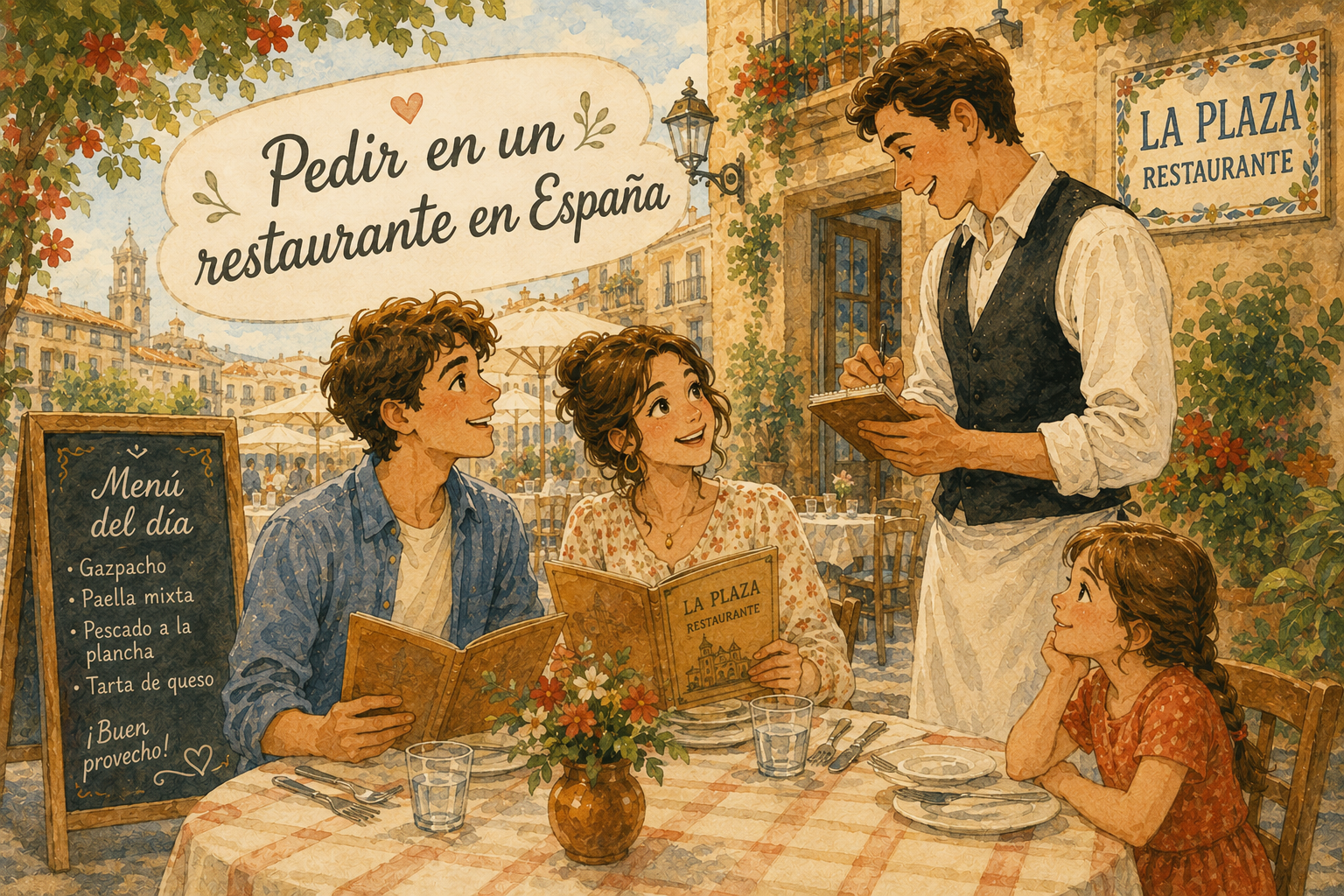
Ir a un restaurante en España tiene sus propias costumbres, horarios y expresiones. Si alguna vez te has quedado en blanco cuando un camarero te pregunta “¿Qué vais a tomar?”, este artículo es para ti.
Going to a restaurant in Spain comes with its own customs, schedules and expressions. If you’ve ever frozen when a waiter asks you “¿Qué vais a tomar?”, this article is for you.
Hoy aprenderás frases reales para desenvolverte en un restaurante en España, desde pedir una mesa hasta pagar la cuenta.
Today, you’ll learn real Spanish phrases to use in a restaurant in Spain, from asking for a table to paying the bill.
1. Al llegar y pedir mesa | Arriving and Getting a Table
Cuando llegas a un restaurante, estas son algunas de las frases más útiles:
When you arrive at a restaurant, these are some of the most useful phrases:
- ¿Tienen mesa para dos/tres/cuatro? — Do you have a table for two/three/four?
- ¿Hay que esperar mucho? — Is there a long wait?
- ¿Nos puede dar una mesa en la terraza, por favor? — Could we have a table on the terrace, please?
- Hemos reservado a nombre de… — We have a reservation under the name…
 Nota cultural | Cultural note: En muchos bares y restaurantes informales españoles no siempre es necesario reservar. Sin embargo, para un restaurante popular un viernes o sábado por la noche, es recomendable reservar con antelación.
In many Spanish bars and casual restaurants, you don’t always need a reservation. However, for a popular restaurant on a Friday or Saturday night, booking in advance is a good idea.
2. Pedir la carta | Asking for the Menu
Una vez sentados, el camarero normalmente traerá la carta. También puedes pedirla directamente:
Once you’re seated, the waiter will normally bring you the menu. You can also ask for it directly:
- ¿Nos trae la carta, por favor? — Could you bring us the menu, please?
- ¿Qué nos recomienda? — What do you recommend?
- ¿Cuál es el plato del día? — What’s today’s special?
- ¿Tienen menú del día? — Do you have a set lunch menu?
El menú del día | The “menú del día”
El menú del día es muy habitual en España, especialmente de lunes a viernes a mediodía. Normalmente incluye un primer plato, un segundo plato, bebida y postre o café por un precio fijo.
The menú del día is very common in Spain, especially from Monday to Friday at lunchtime. It usually includes a first course, a main course, a drink and dessert or coffee for a fixed price.
3. Pedir comida y bebida | Ordering Food and Drinks
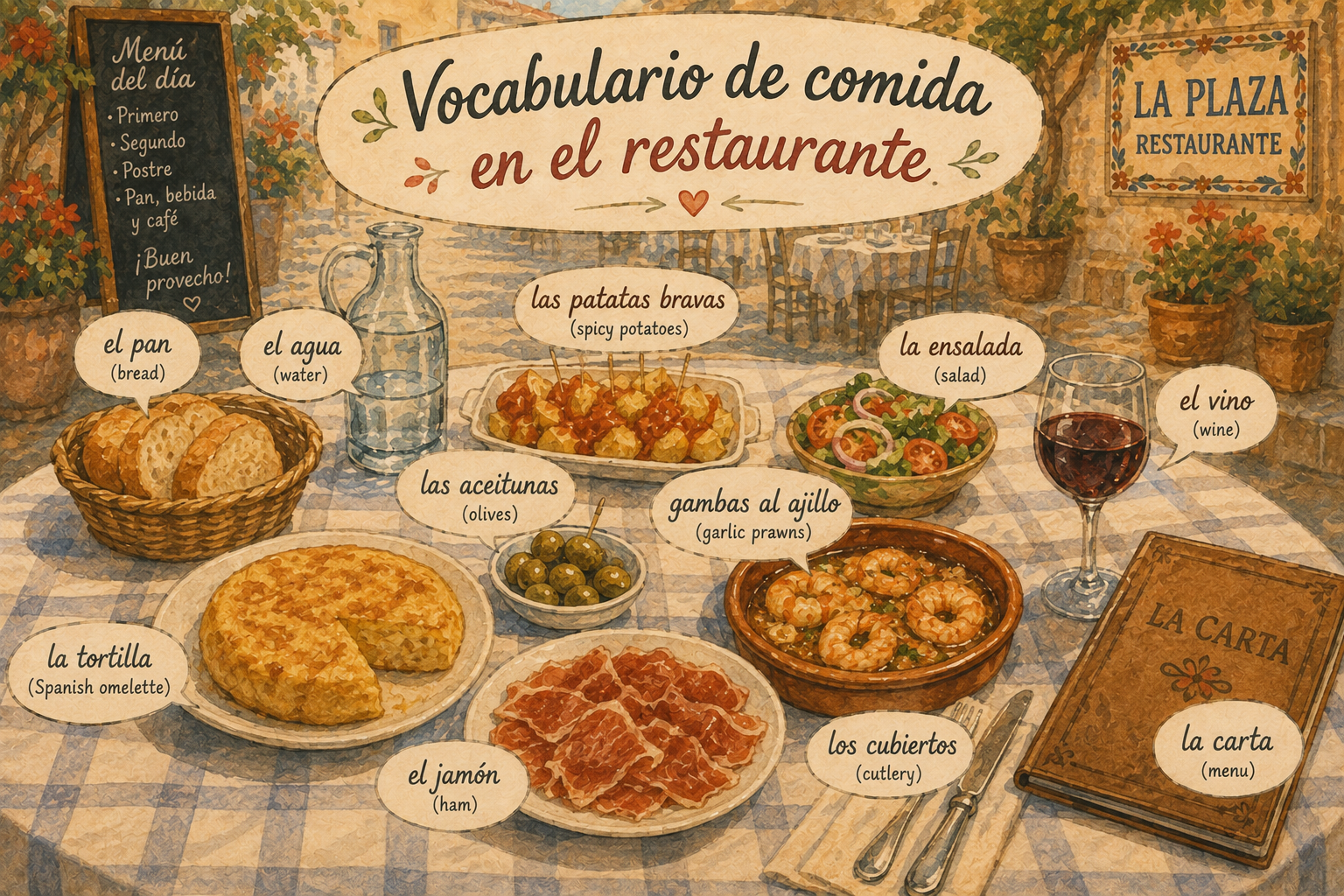
Una comida tradicional en España puede incluir primero, segundo y postre. También es muy habitual pedir varios platos para compartir.
A traditional meal in Spain may include a first course, main course and dessert. It’s also very common to order several dishes to share.
Frases útiles | Useful phrases
- De primero, quiero… — For my first course, I’d like…
- De segundo, para mí… — For my main course, I’ll have…
- Para picar, ¿nos trae unas croquetas? — Could we have some croquettes to share?
- Para compartir… — To share…
- Una copa de vino tinto, por favor. — A glass of red wine, please.
- Agua con gas, por favor. — Sparkling water, please.
¿Qué puede preguntarte el camarero? | What Might the Waiter Ask?
- ¿Qué vais a tomar? — What would you like?
- ¿Y para beber? — And to drink?
- ¿Todo bien? — Is everything OK?
- ¿Qué tal todo? — How is everything?
Consejo | Tip: No necesitas construir una respuesta complicada. “Para mí…” + el plato es una forma sencilla y natural de pedir.
You don’t need to give a complicated answer. “Para mí…” + the dish is a simple and
natural way to order.
4. Hacer peticiones y quejarse educadamente | Making Requests and Complaining Politely
¿Necesitas más pan? ¿Faltan servilletas? ¿Te han traído algo que no habías pedido?
Do you need more bread? Are you missing some napkins? Did they bring you something you didn’t order?
Estas frases te ayudarán:
These phrases will help:
- Perdone, ¿me trae un poco más de pan? — Excuse me, could you bring me some more bread?
- ¿Nos podría traer más servilletas, por favor? — Could you bring us some more napkins, please?
- Disculpe, esto no es lo que había pedido. — Excuse me, this isn’t what I ordered.
- Está buenísimo, gracias. — It’s delicious, thank you!
Consejo | Tip: Perdone y disculpe son dos expresiones muy útiles para llamar educadamente la atención del camarero.
Perdone and disculpe are two useful expressions for politely getting the waiter’s attention.
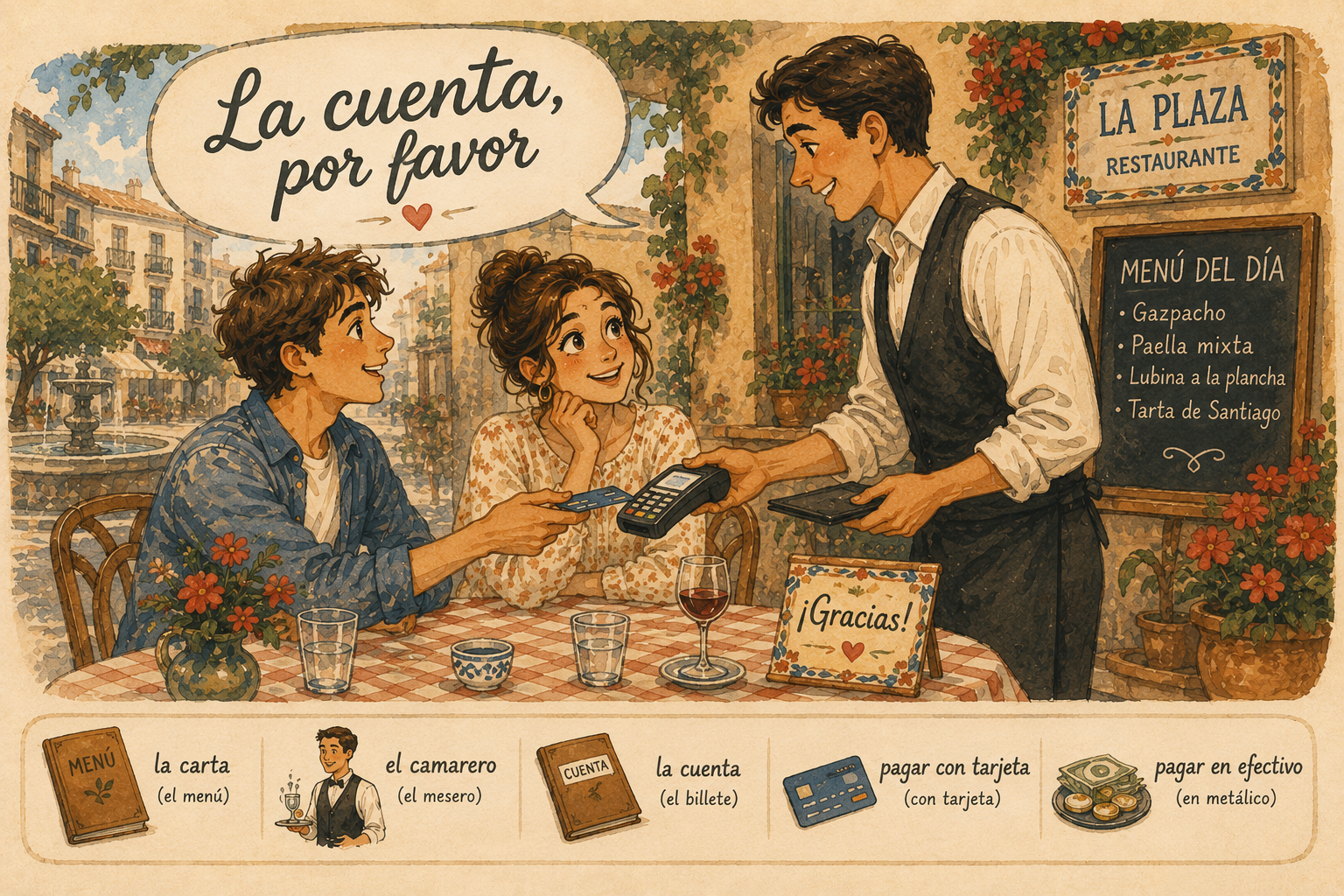
5. Pedir la cuenta y pagar | Asking for the Bill and Paying
En España, el camarero normalmente no traerá la cuenta hasta que la pidas. No significa que se haya olvidado de ti.
In Spain, the waiter will normally not bring the bill until you ask for it. It doesn’t mean they’ve forgotten about you.
Frases esenciales | Essential phrases
- ¿Nos cobra, por favor? — Could we pay, please?
- La cuenta, cuando pueda. — The bill, when you have a moment.
- ¿Se puede pagar con tarjeta? — Can I pay by card?
- ¿Podemos pagar por separado? — Can we pay separately?
Nota cultural | Cultural note: La propina
En España, dejar propina es opcional. No existe un porcentaje fijo que tengas que dejar. Si el servicio ha sido bueno, puedes redondear la cuenta o dejar unas monedas.
In Spain, tipping is optional. There is no fixed percentage you’re expected to leave. If the service was good, you can round up the bill or leave a few euros.
También es habitual que, cuando comes con amigos, la cuenta se divida a partes iguales en lugar de calcular exactamente lo que ha consumido cada persona.
When eating with friends, it’s also common to split the bill equally instead of calculating exactly what each person ordered.
Final Activity
Actividad final
Pon a prueba lo aprendido  | Test What You’ve Learned
¿Quieres aprender español de una forma práctica y natural?
Would you like to learn Spanish in a practical and natural way?
Si quieres mejorar tu español con contenidos reales, actividades, vocabulario y apoyo profesional, te invitamos a formar parte de nuestro club.
If you want to improve your Spanish through authentic content, activities, vocabulary and professional support, we invite you to join our club.
Apúntate aquí:
https://adventurelearningespanol.com/register
We would love to help you speak Spanish with greater confidence and naturalness.
Nos encantará ayudarte a hablar español con más confianza y naturalidad.